
September 4, 2026
An Instant Pot Mystery: The Case of a Stubborn Lid
By Sudeep Kumar, Wizen Academy
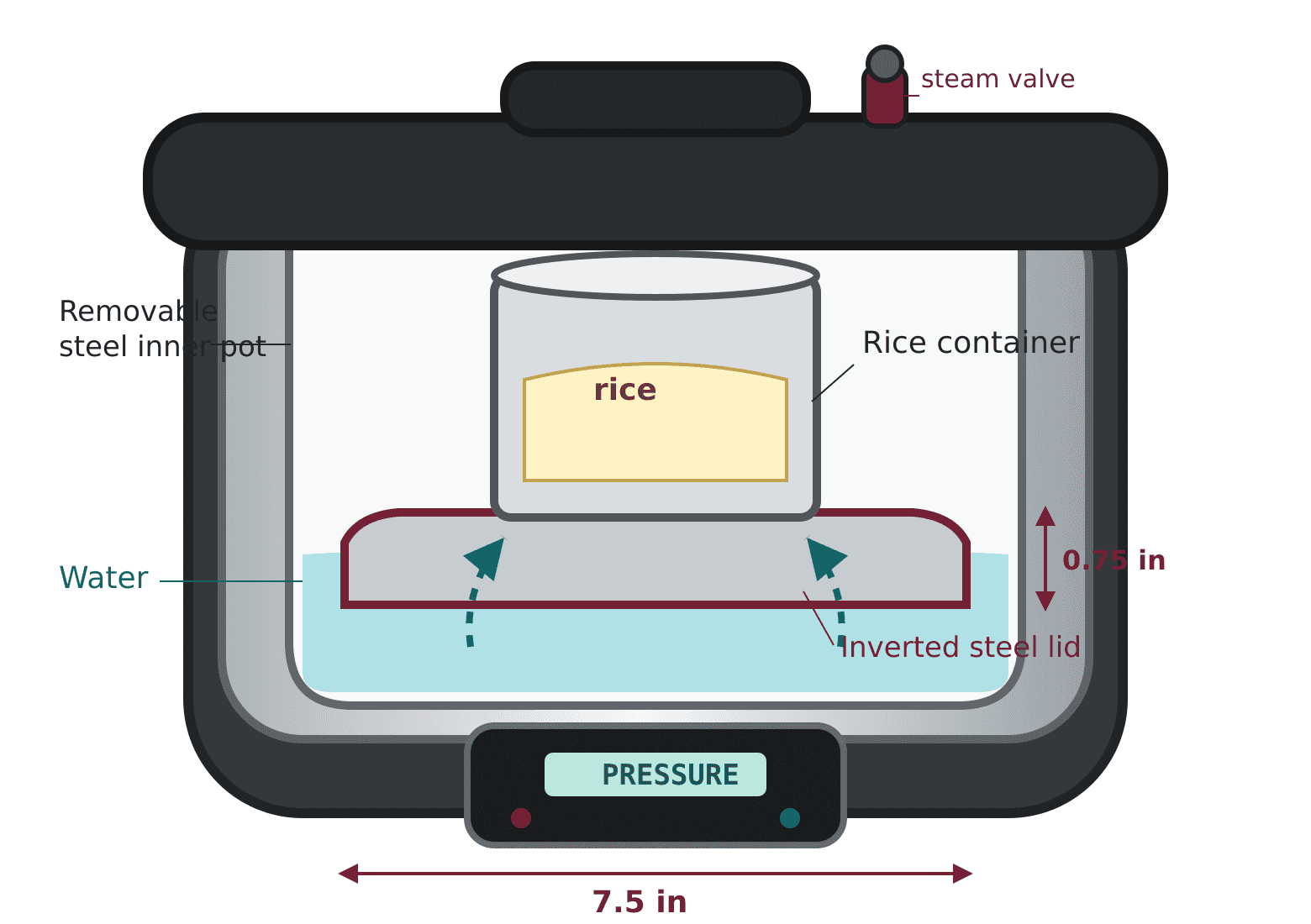
Some kitchen mishaps announce themselves with a bang. Ours announced itself with silence — a small steel lid that had done nothing wrong for the last forty minutes suddenly refusing, on principle, to come out of the Instant Pot.
I'd been cooking rice the lazy-genius way: rather than dump a cup of rice straight into the Instant Pot's main steel liner and deal with the sticky cleanup later, I set a shallow round steel lid — 7.5 inches across, three-quarters of an inch deep — upside down in a little water at the bottom, and balanced a separate round steel container of rice on top of it like a tiny platform. Pot-in-pot cooking. When it's done, you lift the whole thing out, cover the rice with that same lid, and put it straight in the fridge. No second dish, no scrubbing. I was, frankly, a little pleased with myself.
The rice came out fluffy and perfect. Then I reached in to pull that little lid out, and it would not move. Not “stuck a little” — welded-in-place, personally-offended-by-my-existence would not move.
I tried a spoon. I tried the thinnest, sharpest thing in the kitchen drawer. My daughter Shreya joined the effort, and for nearly twenty minutes it was the two of us against one extremely calm disc of steel, while two lunch guests watched with equal parts amusement and curiosity, no doubt wondering when this drama would end and lunch would actually be served. Nothing worked. Eventually we called a truce. “Let's stop pulling on it,” I said, “and figure out why it's stuck instead.”
What had actually happened
While the water underneath the lid was boiling, it was producing steam continuously, and that steam had every opportunity to escape around the loosely-seated rim — hot, active, nothing standing still long enough to seal anything shut. Once we lifted the rice out and let the pot cool, that changed. The steam trapped in the shallow pocket beneath the lid condensed back into a few drops of water, collapsing dramatically in volume, and whatever ordinary air remained in there cooled and contracted right along with it. Outside, atmospheric pressure hadn't gone anywhere. A thin film of water around the rim sealed the gap well enough to keep it from equalizing back in.
It is tempting to call this an “air lock,” but that term actually describes something else — a trapped bubble blocking liquid from moving through a pipe, a plumbing problem. What had formed here was a partial-vacuum seal, or more simply a pressure seal: the lid was not being pulled down by suction from below, it was being pushed down by ordinary air pressure from above, now with much less resistance underneath to push back.
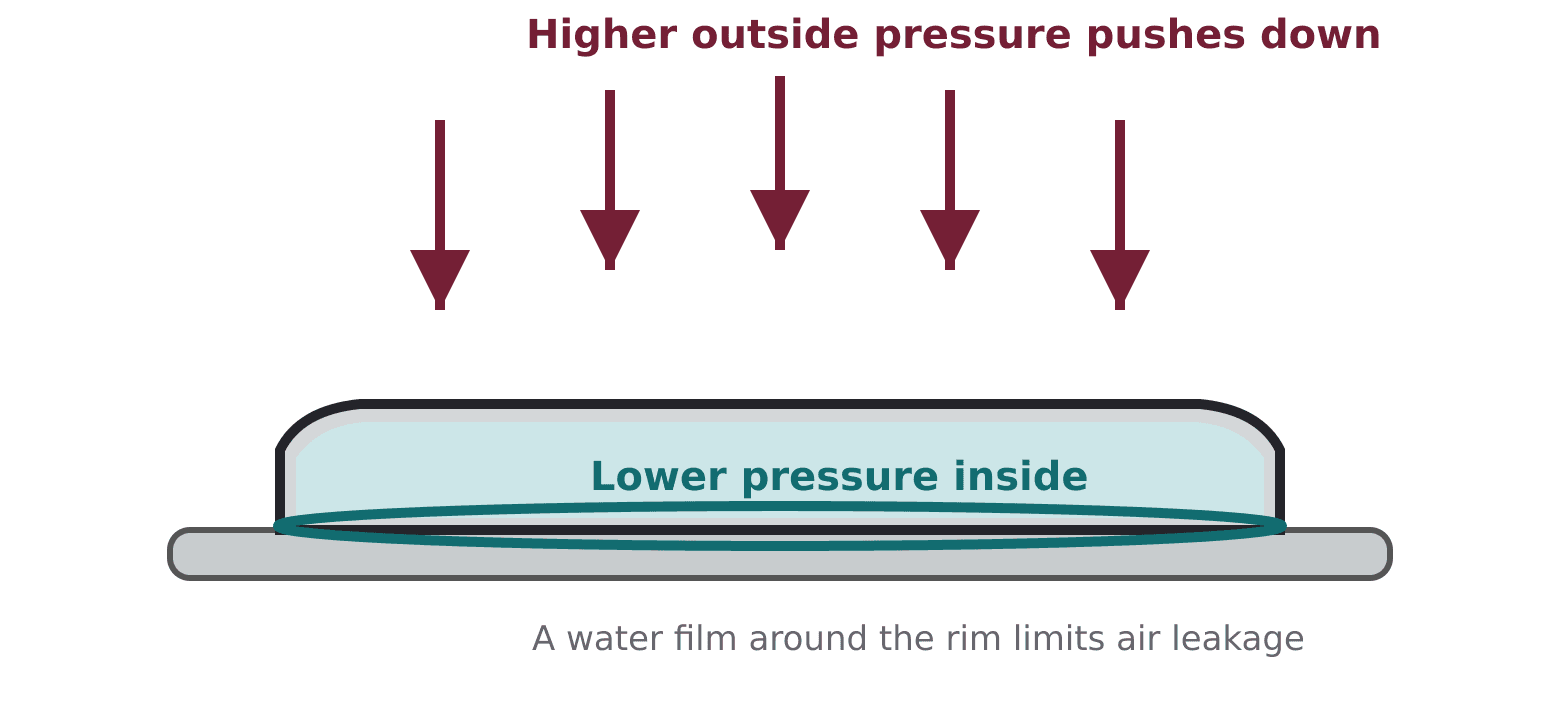
Why was the lid so difficult to move?
That is easy to say and easy to underestimate, so here is the arithmetic. The force created by a pressure difference is
For a 7.5-inch-diameter lid:
area = πr² = π(0.09525 m)² ≈ 0.0285 m² = 44.2 in²
Our lid covers a genuinely large area for this purpose — about 44.2 square inches. Large area means a small pressure imbalance turns into a surprisingly large force.
| Pressure difference | Approximate holding force | Everyday equivalent |
|---|---|---|
| 1% of atmospheric pressure | 28.9 N | 6.5 lb-force |
| 5% of atmospheric pressure | 144 N | 32.5 lb-force |
| 10% of atmospheric pressure | 289 N | 64.9 lb-force |
| Theoretical near-vacuum limit | 2,888 N | 649 lb-force |
The last row is a theoretical upper bound, not a claim about the actual kitchen setup. We were nowhere near it — but even a modest few-percent pressure deficit put us in the range of a person's whole body weight bearing down on a lid we were trying to lift with a spoon. It only takes a little vacuum over a lot of area.
How much space was under the lid?
If we approximate the space beneath the lid by its full cylindrical envelope — 7.5 inches in diameter and 0.75 inch high — its maximum volume is about:
The real trapped volume was smaller than this upper estimate — the lid has a flat center and only a shallow rolled rim. Even so, filling that space with steam at 100°C takes only about 0.32 grams of water, which condenses into roughly 0.32 mL of liquid. A third of a gram of water, disappearing into a third of a milliliter, was enough to hold the whole thing shut.
The fix
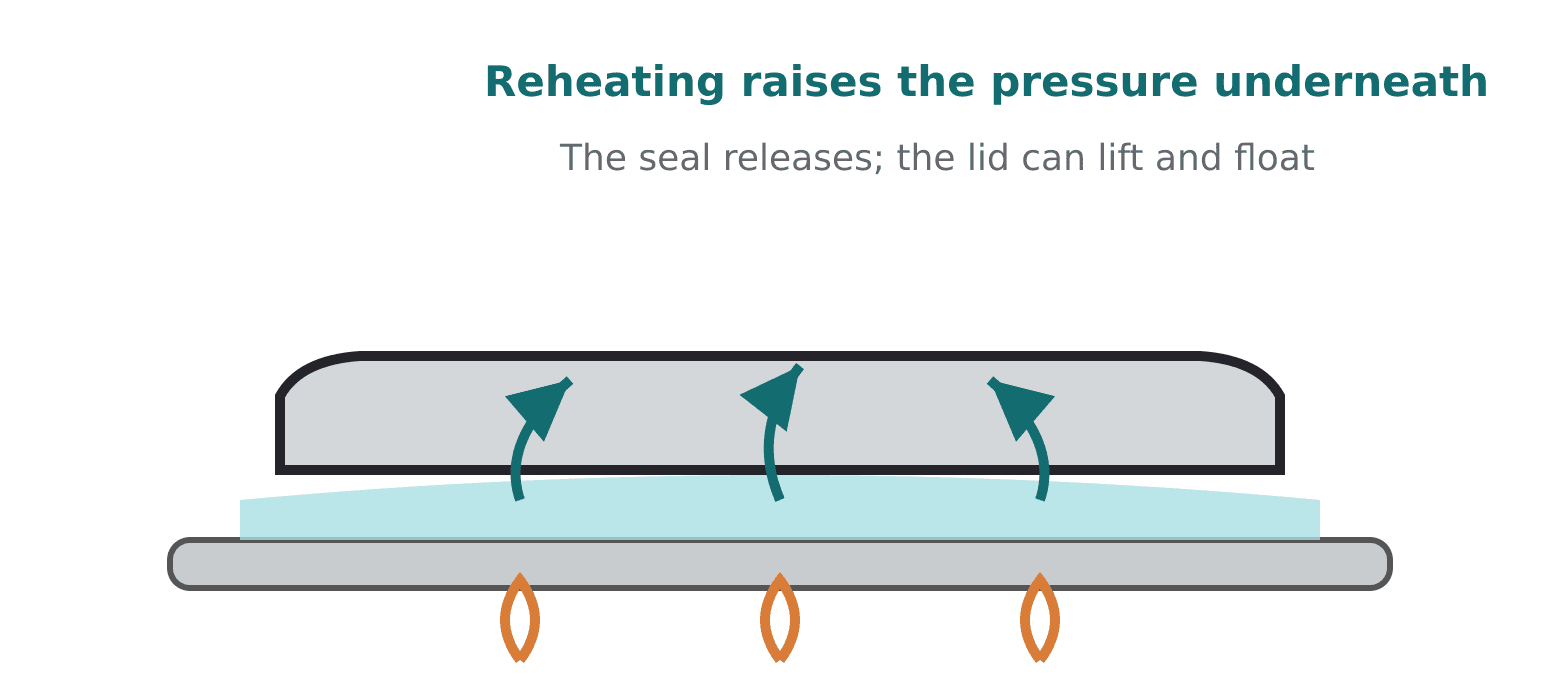
Once we understood the cause, it needed no cleverness at all: back onto the stove, reheat the water until it is steaming again, and the pressure underneath rebuilds until the seal gives way. The lid floated free within a minute, exactly as calmly as it had refused to move twenty minutes earlier.
Shreya and I were relieved, and a little smug about it — she had finished a year of AP Physics only a few weeks earlier, and here it was, paying rent in our kitchen in front of two amused houseguests. We hadn't won by finding a stronger tool. We had won by asking what had actually changed.
The Wizen Academy lesson
- Observe carefully: The lid moved freely hot, and locked up cold.
- Identify what changed: Temperature dropped, steam condensed, trapped pressure fell.
- Name the governing idea: A pressure difference over a large area is a large force.
- Reverse the mechanism: Reheat, restore the pressure, and the effect undoes itself.
Equations matter, but physics is not really the act of picking the right equation. It is the habit of asking what happened, what changed, and which principle explains it — the root cause first, the formula second. Do that, and the solution tends to show up on its own.
Sometimes it even floats up from the bottom of an Instant Pot.
At Wizen Academy, we teach the method of enquiry — how to observe, ask what changed, and see how the concepts we learn show up in everyday life. If that is the kind of thinking you want your child to build in math and physics, we would love to help.
 Scan to register
on your phone